Classical Mechanics
12/20/2007
Stanford
class with Leonard Susskind.
Goal: create a body of amateur Physicists. people are interested in physics, but not employed by a University. For people who don’t otherwise have access to a graduate course.
Poisson brackets formulation were used to describe phase space and flow in phase space.
Imagine a rotation of a system. Coordinates are  . The rotation transformation may mix the p’s and q’s.
Axiomatic structure of Poisson Brackets
 Antisymmetric
 Linear
 Product rule

 (the Kronecker
delta)
(the Kronecker
delta)
 and
and 
The momentum is related to the partial derivative.

Proof:
•
1st show that the relation is true when  is a polynomial.
Start with a constant term. Any constant will do.
 by product rule

Now try 1st power of  .
.
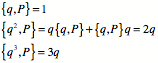
The pattern is that of a derivative. The proof is by mathematical induction.

and similarly
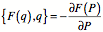
The time derivative along a trajectory
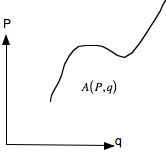
as before,

Example:

then

Canonical Transformations of Poisson Brackets
Question: what are the allowable transformations that preserve the Poisson Bracket properties?
Example of a transformation.
 does not
preserve properties since
does not
preserve properties since  ?
?
However
 does
preserve the properties.
does
preserve the properties.
Example: Rotation.
We need to check only  since
since  by antisymmetry!
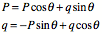

Therefore the structure is preserved.
Canonical transformations keep the relations unchanged.
Investigate an infinitesimal transformation. (suppress indices)

Drop infinitesimal quadratic terms.

It is necessary and sufficient that the following be true in order to maintain the Poisson Bracket structure:

Assume a generator function  . Now substitute into a canonical transformation.
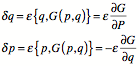
Always defines a canonical transformation.

So  is also a
generator of another flow, another canonical transformation.
is also a
generator of another flow, another canonical transformation.

to get
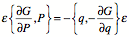
therefore since

then

Consider canonical transformations that do not change the energy. That transformation is a symmetry.
Consider the time derivative of 

Don’t know where this goes:
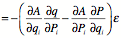
If the energy is not changed, then
 Generator
commutes with the Hamiltonian so that
Generator
commutes with the Hamiltonian so that  is conserved.

Example: A canonical transformation (a rotation). Let

Let

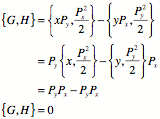
Therefore  is conserved
under the rotation.
is conserved
under the rotation.
Make up a new system. Let

then

Therefore, circular motion.
Example:

then

Homework: Prepare for Quantum Mechanics next semester. Look at iTunes “Quantum Entanglement, the Logic of Discrete Systems”.
The end of the semester.